
Click to zoom
Description
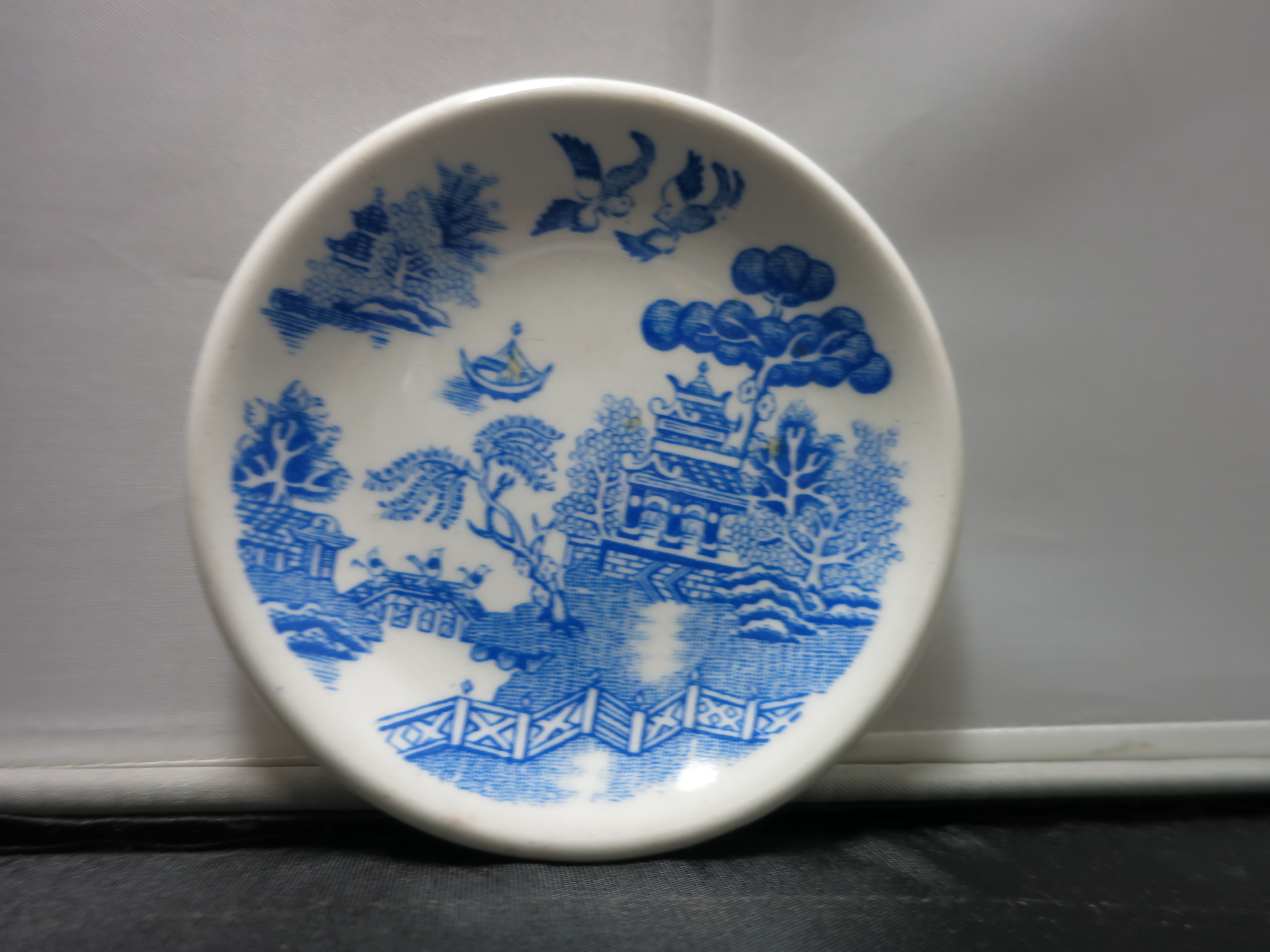
Dunn Bennett & Co Ltd Blue Willow Butter Pat. This is a nice harder to find butter pat marked, Dunn Bennett & Co Ltd, Burslem England. Also has a symbol and the number 9 stamped on the back. Measures 3 3/8 inch across the center. No chips, no cracks and no crazing. This is a lighter blue in color then most blue willow, but is original blue willow pattern and lovely.
Here are some blue willow facts:
Even though the Blue Willow pattern has a Chinese look and story, it was actually created in England in 1780 by engraver Thomas Minton. Then, Minton sold the design to potter Thomas Turner who mass-produced the pattern on earthenware. This is known as chinoiserie, basically European interpretations of Chinese decorative styles. Chinoiserie was very popular in the 17th and 18th centuries. Ultimately, many countries produced it, but it wasn’t made in China until the mid-1980s.
All authentic patterns have a few things in common
To be a true Blue Willow pattern it must include:
willow trees. Chinese pine trees (commonly confused as apple or orange trees)
a bridge with three men on it
a fence
a boat
a teahouse (or pagoda) and
two birds in flight.
Please ask any questions.
Shipping cost actual cost, no handling fee.
Please search for Allies Vintage Alley to see my online store.
Specifications
| Condition | Good |
| Weight | 1–5 lbs |
| SKU | MBG-576 |
Dunn Bennett & Co Ltd Blue Willow Butter Pat
$18.00
Shipping calculated at checkout
Fulfillment
Shipping or Local Pickup
Saint Albans, VT
Handling Time
Ships within 2 days
Estimated Delivery
5-7 business days
Description
Dunn Bennett & Co Ltd Blue Willow Butter Pat. This is a nice harder to find butter pat marked, Dunn Bennett & Co Ltd, Burslem England. Also has a symbol and the number 9 stamped on the back. Measures 3 3/8 inch across the center. No chips, no cracks and no crazing. This is a lighter blue in color then most blue willow, but is original blue willow pattern and lovely.
Here are some blue willow facts:
Even though the Blue Willow pattern has a Chinese look and story, it was actually created in England in 1780 by engraver Thomas Minton. Then, Minton sold the design to potter Thomas Turner who mass-produced the pattern on earthenware. This is known as chinoiserie, basically European interpretations of Chinese decorative styles. Chinoiserie was very popular in the 17th and 18th centuries. Ultimately, many countries produced it, but it wasn’t made in China until the mid-1980s.
All authentic patterns have a few things in common
To be a true Blue Willow pattern it must include:
willow trees. Chinese pine trees (commonly confused as apple or orange trees)
a bridge with three men on it
a fence
a boat
a teahouse (or pagoda) and
two birds in flight.
Please ask any questions.
Shipping cost actual cost, no handling fee.
Please search for Allies Vintage Alley to see my online store.
Specifications
| Condition | Good |
| Weight | 1–5 lbs |
| SKU | MBG-576 |